
Many people today are talking about diets that are “gluten-free.” Restaurants are offering “gluten-free” menus. There are websites, chiropractors, and others proclaiming that going on a gluten-free diet will provide improved health. But lets be clear- unless you have an allergy to gluten, removing gluten from your diet will not provide better health, weight loss, but eliminating gluten will dramatically limit what you can eat.
But there are some people who are “allergic” to gluten- and for them having a gluten free diet is the difference between health and illness – between a risk of some rare cancers for which we don’t have great treatment for. We call that condition celiac disease – for those who have celiac disease, being gluten free is critical. Other names for this disease include celiac sprue, gluten sensitive enteropathy, non-tropical sprue, and a few other names.
Gluten is a protein that is found in wheat, barley, rye, and oats. Gluten is a protein that allows wheat to have “elasticity” – meaning you can roll out the dough- or toss it in the air and make a great pizza crust. You can’t do that with non-gluten grains—no one can make a pizza or great bread from corn alone. Gluten is also used to thicken soups, ketchup, soy sauce, and is found in almost every processed food out there. Take gluten out of the American diet and you will be challenged to find good alternatives.
When a person is allergic to gluten their symptoms include malnutrition, anemia, osteoporosis, infertility, short stature, and inability to thrive. However, the “classic” symptoms are not necessarily common. There are a number of patients who have silent celiac disease, where they will be discovered to have atrophy of their absorptive surface of the small bowel without any symptoms, or just mild symptoms such as an iron deficiency anemia. There are a number of forms of celiac disease that respond well to a gluten free diet – and remain normal after introduction of gluten into the diet.
Celiac disease is best diagnosed with a biopsy of the small intestine. Most often the biopsy is performed endoscopically from the first part of the small bowel, the duodenum. However, those biopsies can be negative, and more distal small bowel may show the classic pathologic appearance. Those biopsies most often have to be done surgically, or with advanced endoscopic equipment.
The small bowel, under a microscope, has many small finger-like projections called villi. These serve to increase the surface area of the small bowel to allow for maximum absorption of nutrients. In celiac disease, there is atrophy of these villi – seen microscopically- and this improves when gluten is removed from the diet.
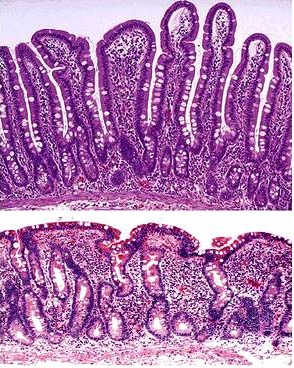
Above normal villi, below- atrophied
While celiac disease is classically called an “allergy” to gluten – it does promote some antibodies against the connective tissue elements – leading physicians to call this an auto-immune disease. However, when the foreign protein is withdrawn, there is no residual auto-immune function. Hence, no gluten and people improve however true celiac disease still has a higher than normal incidence of small bowel cancer, and that incidence does not decrease with elimination of gluten..
There have been various reports about the prevalence of celiac disease – ranging from 1:300 among Northern Europeans (Celtic) to 1:122. There is a large genetic distribution of the disease – with a high concordance among identical twins of up to 70 per cent. There are some genetic markers that have a high association with celiac disease, but the expression of the disease is variable – meaning that the genetic marker is a tendency but not a certainty of celiac disease. If everyone who had the genetic markers were to develop the disease, it would be estimated that 1 in 22 people would have this. However, this is not the case.
Diagnosis of celiac disease is made based on clinical suspicion of the classical presentation (iron deficiency, osteoporosis, with abdominal complaints) followed by some tests. A biopsy is the most reliable test, however there are blood tests ( IgA anti-gliadin and IgA anti-endomysial and anti-tissue transglutaminase) that are over 90 per cent accurate. Even with a negative blood test but a high enough suspicion, duodenal biopsy or even surgical biopsy is warranted.
There are plenty of questions about celiac disease- we don’t know the actual prevalence in the population, we don’t know if being gluten free as demonstrated by follow up biopsy has a lower incidence of lymphoma.
What we do know is that gluten is not a health issue in people who do not have celiac disease. Gluten-free will not cure autism. Gluten free will not facilitate weight loss. There are, however, groups who will claim that gluten is a health issue- there is no basis for this claim. If someone has told you to remove gluten from your diet, and you do not have a test showing celiac disease (one of the tests listed above)- please see a physician to resolve this.
For people who have celiac disease- there is a bit of culinary hope. Thomas Keller, one of the world’s greatest chefs and owner of Ad Hoc, French Laundry, Per Se, and Bouchon- has developed a flour that works well. You can purchase it from Williams-Sonoma.
But gluten-free products have more sugar- and are not any “healthier” for you if you don’t have a gluten issue.
Most people have no idea what gluten is- they don’t know it is a protein that is rich in proline amino acids. They just hear that “its bad.”
Science and tests are clear – if you don’t have celiac disease, you don’t need to avoid gluten. If you have gluten sensitivity the reality is that it is in your mind, and not your gut.

Thomas Keller has come up with a great flour, gluten Free.
