
When Beef Becomes Belief: The Carnivore Priesthood
Nutrition debates rarely begin with money. Yet money almost always explains how they spread.
That fact explains much of the modern carnivore movement.
At first glance the carnivore diet appears to be a radical nutritional idea: eat beef, organs, and animal fat while avoiding vegetables, grains, legumes, and most fruits. Advocates often present the idea as a return to ancestral eating. According to the story, prehistoric humans thrived on meat, and modern illness appeared only after plants and processed foods entered the menu.
However, once you look past the rhetoric, another pattern appears. The carnivore movement did not grow out of decades of clinical research. Instead, it grew out of a very modern ecosystem: social media, podcasts, influencer culture, and supplement companies.
And once that ecosystem forms, the incentives become clear.
First someone declares that conventional nutrition science has misled the public. Next they present a dramatically simple solution. Afterward they build a community around that solution. Eventually products appear—supplements, coaching programs, special meat boxes, laboratory panels, and branded lifestyle advice.
In other words, the diet becomes the marketing engine.
And beef becomes the sacrament.
Why Simplicity Sells
Extreme diets succeed for a reason. Complexity frustrates people, while simplicity reassures them.
“Eat a balanced diet rich in vegetables, whole grains, legumes, fish, and moderate meat” may represent excellent advice supported by decades of research. Unfortunately, that advice does not travel well on social media.
By contrast, statements such as “plants are poison” or “fiber is unnecessary” spread rapidly. Bold claims generate engagement. Engagement produces followers. Followers create revenue streams.
Consequently, the carnivore diet does not function only as a nutritional recommendation. It functions as a brand.
Once someone builds that brand, they must defend it.
The Prophets: The Case of the Liver King
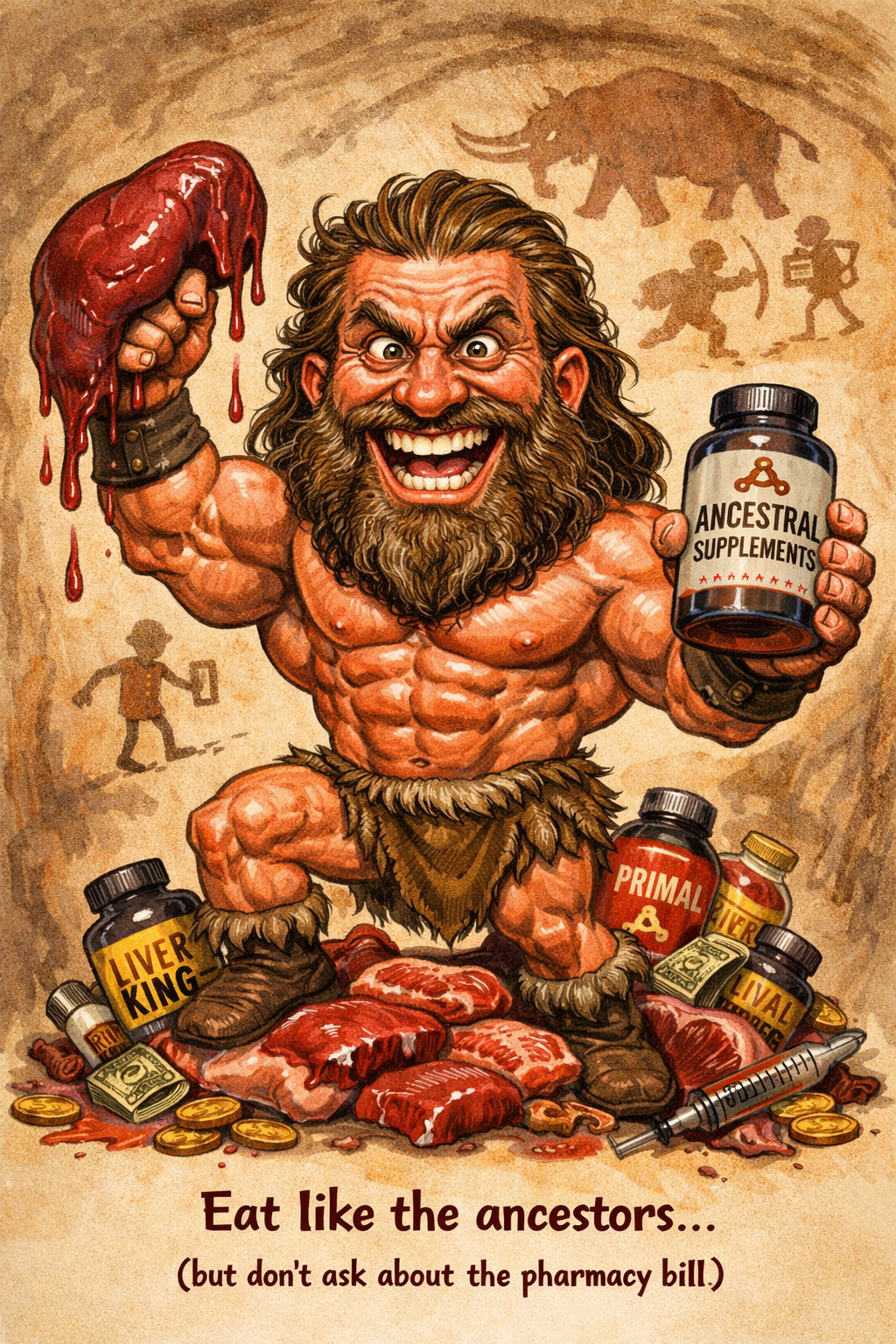
Every belief system eventually develops its prophets, and the carnivore world found one in a man who called himself Liver King.
He appeared online with an enormous beard, an even larger physique, and a simple message: modern men had grown weak because they abandoned the practices of their prehistoric ancestors. According to his message, people should eat raw organs, train like cavemen, reject modern foods, and adopt “ancestral living.”
Conveniently, the ancestral lifestyle also included supplements he sold through his company.
The marketing proved effective. The image of a muscular barbarian rejecting modern science attracted millions of followers and produced a supplement business worth tens of millions of dollars.
Unfortunately, the story collapsed in 2022 when leaked emails revealed the Liver King spent more than $10,000 per month on anabolic steroids and other performance-enhancing drugs. Shortly afterward, he admitted publicly what physicians suspected from the beginning.
Raw liver did not build that physique.
Pharmacology did.
Nevertheless, the episode illustrates the economic logic of the carnivore movement. First comes the doctrine. Then comes the identity. Finally come the products.
The Theologians: Paul Saladino
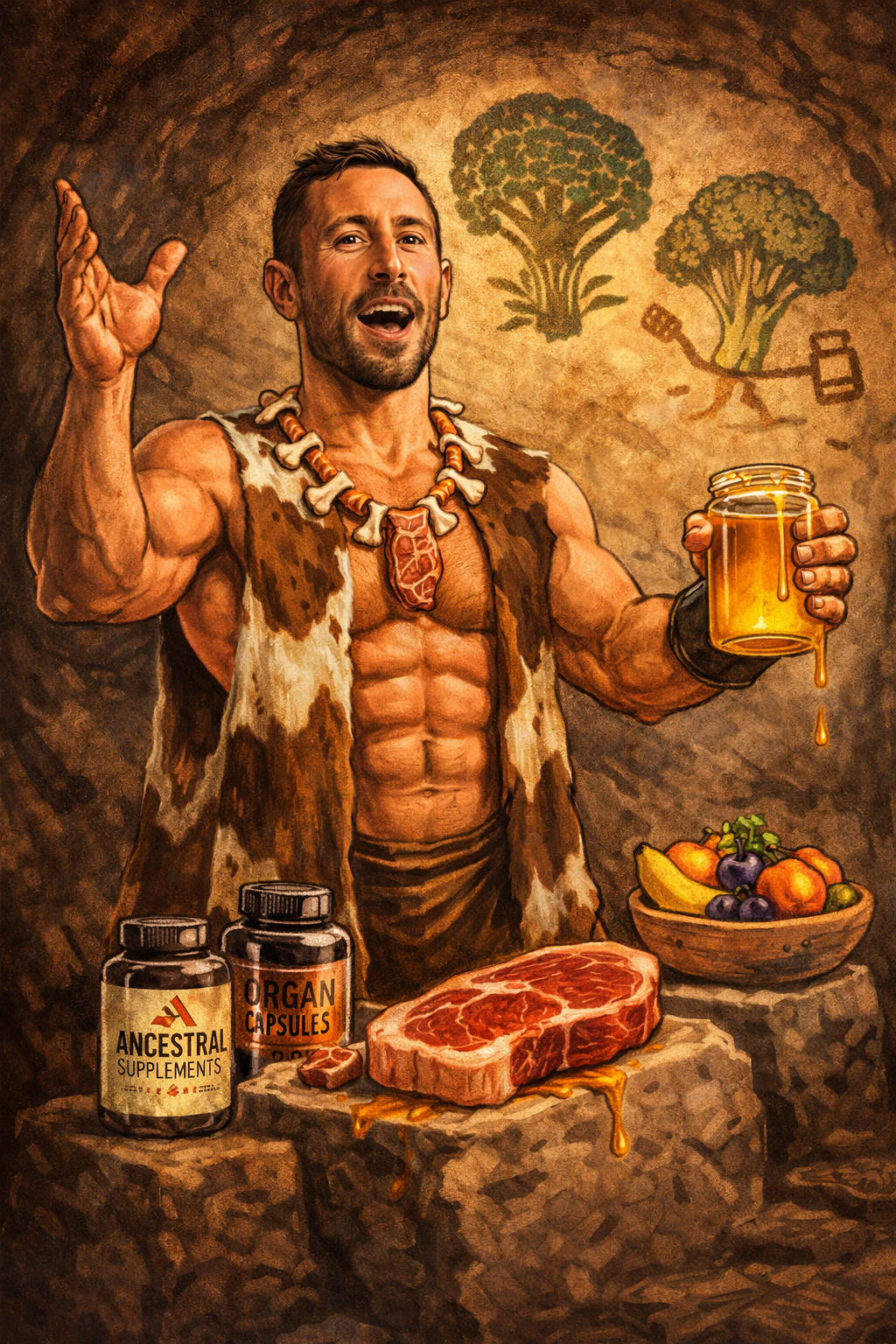
Movements rarely survive on prophets alone. They also require theologians—people who explain the doctrine with intellectual confidence.
Within the carnivore community, one of the most prominent interpreters has been Paul Saladino, a physician originally trained in psychiatry who later rebranded himself as Carnivore MD.
For several years his message remained uncompromising. Plants contained toxins. Vegetables acted as chemical weapons. Humans thrived best on meat, organs, and animal fat. His book The Carnivore Code argued that modern civilization misunderstood nutrition and that health required a return to meat-centered eating.
However, the human body eventually entered the conversation.
After spending years on a strict carnivore diet, Saladino described several physiological problems: poor sleep, heart palpitations, muscle cramps, and hormonal changes. Consequently, the diet evolved.
Fruit appeared. Honey appeared. Raw dairy appeared.
Today, the diet carries a new label—an “animal-based diet.” In practice, that means meat accompanied by carbohydrates from fruit and honey.
In other words, the diet rediscovered sugar.
This pattern appears frequently in nutrition movements. Early stages emphasize purity and certainty. Later stages quietly reintroduce flexibility when biology refuses to cooperate.
Also, Paul is partners with Liver King.
The Economic Engine
The economic component remains impossible to ignore.
Carnivore influencers rarely restrict themselves to books and podcasts. Instead, they build supplement companies that sell freeze-dried organs, nutrient capsules, and other “ancestral” products. The marketing narrative follows a familiar path.
Modern food supposedly lacks essential nutrients.
Ancient diets supposedly provided them.
Supplements conveniently deliver them.
When followers adopt the diet, they often purchase the products associated with it. Over time, they invest not only money, but identity in the movement. As a result, they defend the doctrine aggressively, particularly when new treatments threaten the narrative.
The GLP-1 Conflict
This dynamic explains the hostility many carnivore influencers display toward GLP-1 medications, such as semaglutide and tirzepatide.
GLP-1 drugs reduce appetite, improve metabolic health, and produce significant weight loss in clinical trials. For many patients, they represent the most effective medical treatment for obesity ever developed.
However, GLP-1 therapy undermines the core promise of the carnivore movement. Influencers claim that diet alone solves metabolic disease. Pharmaceutical treatments challenge that claim.
Moreover, if people lose weight and improve health through medical therapy, they may no longer feel compelled to purchase expensive supplements or coaching programs.
Consequently, the drugs become ideological enemies.
Carnivore influencers often portray GLP-1 medications as dangerous, unnatural, or morally suspect. Their followers repeat these arguments across social media platforms, especially on X (formerly Twitter), where the debate frequently resembles a religious dispute, not a scientific discussion.
Within this worldview, GLP-1 therapy resembles a rival faith.
And rival faiths provoke rebellion.
The Cave Painting Argument
Carnivore advocates occasionally invoke another argument that sounds persuasive until examined closely.
If humans historically consumed vegetables, they ask, why do cave paintings rarely depict them?
The answer lies in the purpose of cave art.
Prehistoric artists painted dramatic events—hunts, animals, danger, survival. These images celebrated moments that mattered in a world where food sometimes fought back.
Nobody returned from hunting mammoths and announced, “Let us commemorate this carrot.”
Cave art told stories.
It did not document grocery lists.
Moreover, the absence of broccoli in cave paintings has an obvious explanation. Broccoli did not exist during the Paleolithic era. Mediterranean farmers cultivated it from wild brassica plants thousands of years later, likely beginning with the Etruscans.
Using cave paintings to prove humans were carnivores resembles using medieval paintings to argue that humans never drank coffee.
Humans Have Always Been Omnivores
Anthropology provides a far more realistic picture.
Scientists studying ancient bones, tools, and coprolites—preserved human feces—consistently find evidence of diverse diets that included roots, tubers, fruits, seeds, fish, and meat.
Geography shaped these diets. Arctic populations consumed more animal foods, while equatorial societies relied heavily on plants.
However, no civilization in human history survived entirely on beef.
Flexibility—not purity—allowed our species to thrive.
The Culinary Problem
Carnivore advocates rarely discuss another drawback of the diet.
It is monotonous.
Human cuisine represents one of the great achievements of civilization. Across cultures people combine vegetables, grains, spices, and animal foods into extraordinary traditions that reflect geography and history.
Reducing that diversity to an endless rotation of ribeye steaks diminishes both nutrition and culture.
Beef remains delicious. I enjoy it myself. Growing up on a small island in Alaska, I rarely saw beef because it cost too much to ship. Consequently it felt special when it appeared at the table.
Yet eating beef every day does not create cuisine.
It creates repetition.
Is the Carnivore Diet Safe?
Many readers ask a simple question: Is the carnivore diet safe? Short-term, some people lose weight on a carnivore diet because they eliminate ultra-processed foods and increase protein intake. However, long-term health outcomes remain far less reassuring. Diets that exclude vegetables, legumes, fruits, and whole grains remove important sources of fiber, phytonutrients, and micronutrients that support gut health, metabolic regulation, and cardiovascular protection. Large population studies consistently associate dietary patterns rich in plant foods—such as the Mediterranean diet—with lower risks of heart disease, diabetes, and certain cancers. In contrast, diets dominated by red meat and lacking dietary fiber raise concerns about cardiovascular disease, colon health, and long-term metabolic effects. In other words, the real question is not whether beef can be part of a healthy diet—it certainly can—but whether eliminating most other foods improves health. Current scientific evidence suggests the answer is no.
The Real Lesson
Beef is nutritious.
Steak is wonderful.
But beef does not deserve a priesthood.
When a diet eliminates half the grocery store, sells supplements as sacred tools, and treats competing medical therapies as heresy, the conversation no longer resembles science.
Instead it begins to resemble theology.
And theology rarely improves nutrition.
References
-
Willett W et al. Mediterranean diet and cardiovascular disease. N Engl J Med. 2018
-
Satija A, Hu FB. Plant-based diets and cardiometabolic health. JAMA Intern Med. 2017
-
O’Keefe SJ. Diet, microbiome, and colon health. Nat Rev Gastroenterol Hepatol. 2019
-
IARC Working Group. Red and processed meat and cancer risk. Lancet Oncology. 2015
-
Eaton SB, Konner M. Paleolithic nutrition revisited. NEJM. 1985
