
Let’s Start With What Nobody Tells You
When people start a GLP-1, they are told what to avoid. What side effects to expect, and sometimes how much protein they should be eating. While that information has its place, it misses the part that actually changes your day-to-day life. Because what really shifts is not just how much you eat, but also how you experience it.
At first, that change can feel subtle, almost easy to miss. Because nothing dramatic happens overnight. Although for me it did. In addition, over the course of a few days and weeks, you begin to notice that foods you used to reach for automatically no longer have the same pull, and simultaneously, foods you barely thought about before start to feel more interesting, more satisfying, and more worth your attention.
So instead of asking what you should eat, a better question becomes what you actually want to eat. Because that answer starts to change.
The Old Way: Eating Without Noticing
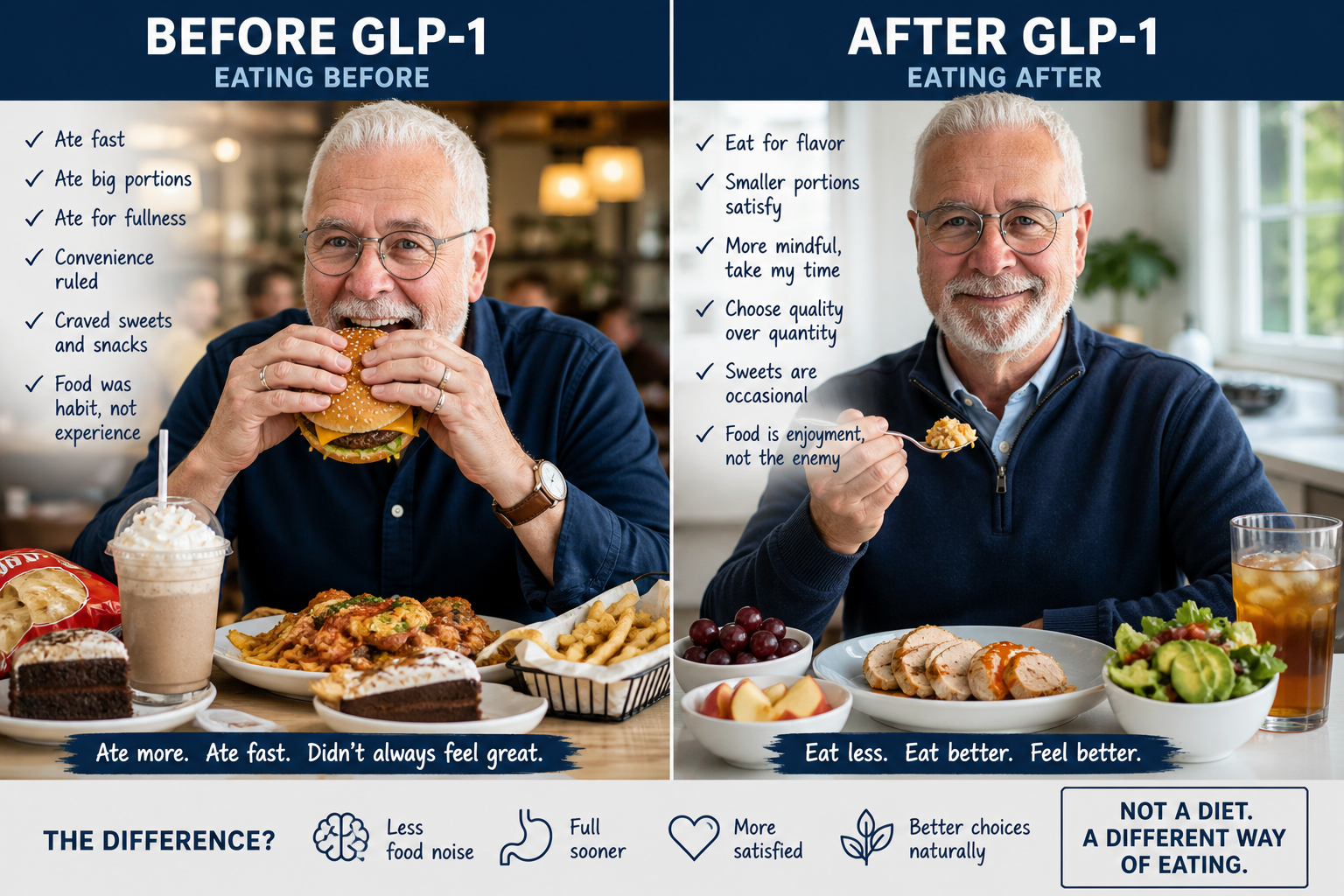
Before this, eating was often fast, automatic, and driven by something that wasn’t quite hunger. Most meals were about filling up rather than tasting anything. Once the plate was in front of you, it didn’t take long for it to disappear.
In many cases, food was less about enjoyment and more about reaching that point of fullness where the urge to eat finally quieted. Which meant convenience foods made sense, large portions felt normal, and finishing everything was exactly what you did.
As a result, you weren’t really tasting food; you were processing it. And that difference matters more than people realize.
Then the Shift Begins
After starting a GLP-1, the signal changes. While it doesn’t happen the same way for everyone, it shows up quickly enough that you notice it in small ways. Because you slow down without trying, you pause between bites without thinking, and you stop earlier than you used to.
That pause is important because it gives you a moment to notice what you’re eating. Once you notice, you start making choices that feel different from before, not because you are forcing yourself to be disciplined, but because your body is guiding you in a new way.
Gradually, eating becomes less about quantity and experience, and that shift changes everything.
Lunch: Where Real Life Happens
For most people, lunch is not a carefully planned event, and that’s exactly why it’s a good place to see what actually works.
On many days, I keep it simple because simple is reliable. A chicken breast heated up in the morning with a bit of hot sauce does the job without much effort. while a couple of apples and some grapes can carry me through the late morning and early afternoon without feeling like I need a full sit-down meal. Plus, if I am driving, eating slices of apples and grapes keeps me awake.
At the same time, I don’t force structure onto it, because grazing a bit throughout the day often fits better than trying to recreate the old idea of a formal lunch, and that flexibility makes things easier rather than harder.
On other days, I might grab a sandwich, and while it could be like a triple-decker club. The difference now is not what I order, but how much I eat, because stopping halfway feels natural instead of forced. Whatever is left has a way of disappearing quickly once my son gets home from school.
Eating out follows the same pattern, because one or two tacos are usually enough. While fried foods sometimes feel heavier than they used to, grilled or ceviche-style options bring out flavor without that weight, making the experience better without trying to optimize anything.
Simple Food Becomes Better Food
At some point, you realize that simple foods start to feel more satisfying than they used to. And something like a good tuna, mixed with yogurt, lemon, and a bit of mustard, becomes a meal that you actually look forward to. Rather than something you eat because you think you should.
Bread becomes optional, not forbidden, and sometimes a bowl or a few crackers is all you need, which removes the sense that meals must follow a certain format.
Seasonal fruit fits into that pattern. Because when something tastes good, you eat it, and when it doesn’t, you move on, which is a different mindset from trying to force certain foods into your day.
Even something as simple as peanut butter and jelly can feel satisfying again, because the experience of eating it has changed.
Hydration Stops Being an Afterthought
One thing that becomes more noticeable is how important drinking fluids actually is because when you eat less, you naturally take in less water from food, and that means you have to be more intentional about it.
For me, iced tea works because it adds a bit of flavor without adding much else. Making it overnight in a pitcher means it’s ready when I need it, which turns hydration into a habit instead of something I forget about.
That small shift makes a bigger difference than most people expect, because feeling off is often just a sign that you need to drink more.
Dinner Becomes Something Different
Dinner changes in a way that feels less structured and more creative. Because instead of trying to build a large meal, you start thinking about what would actually be enjoyable.
Cooking becomes more interesting, not because you are trying harder, but because you have the space to pay attention. Dishes like salmon, pasta with a well-made sauce, or even something new from a meal kit can feel like something you are exploring rather than something you are consuming.
At the same time, there is more room for variety, because you are not relying on volume to feel satisfied, and that allows you to try different things without needing to make them large.
Still Paying Attention Matters
Even with all these changes, I still track what I eat using Noom. Because awareness doesn’t go away just because the biology works differently. And that habit keeps things grounded without turning it into something rigid.
Going out to eat is still part of life, and in many ways, it becomes more enjoyable because you can focus on what you like rather than how much you can eat, and sharing a meal or splitting something becomes a natural part of the experience.
Dessert Tells You More Than You Think
Dessert is where you can see the shift.
Most of the time, I don’t think about it, and that alone is different, because it used to be automatic.
Every now and then, especially when I’m getting close to my next dose, I’ll notice that I want something sweet, and I might have an ice cream bar, and that’s enough.
That moment says more than any rule ever could. It shows the drive is lower, not gone, and that you can respond to it without being controlled by it.
The Real Change
What has changed is not complicated, but meaningful.
I go for flavor instead of volume.
Timing, now I take my time tasting instead of rushing.
Choosing where and what to eat depends on whether it is worth it, not whether it is popular or convenient.
Food is not the enemy.
It never was.
Some days, I am simply not interested in dinner, and if lunch was larger, I might just have a protein shake and move on, because eating is no longer something I have to do on a schedule.
A Different Way of Eating
This is not a diet. It is not a plan. It is not about perfection.
Instead, it is about eating in a way that matches how your body now works, which means paying attention, making choices, and allowing yourself to enjoy food without relying on it for everything else.
Before, I filled my mouth before thinking, and swallowing before experiencing.
Now, I taste.
