
Animal Protein and Cancer Risk: What the Science Really Says
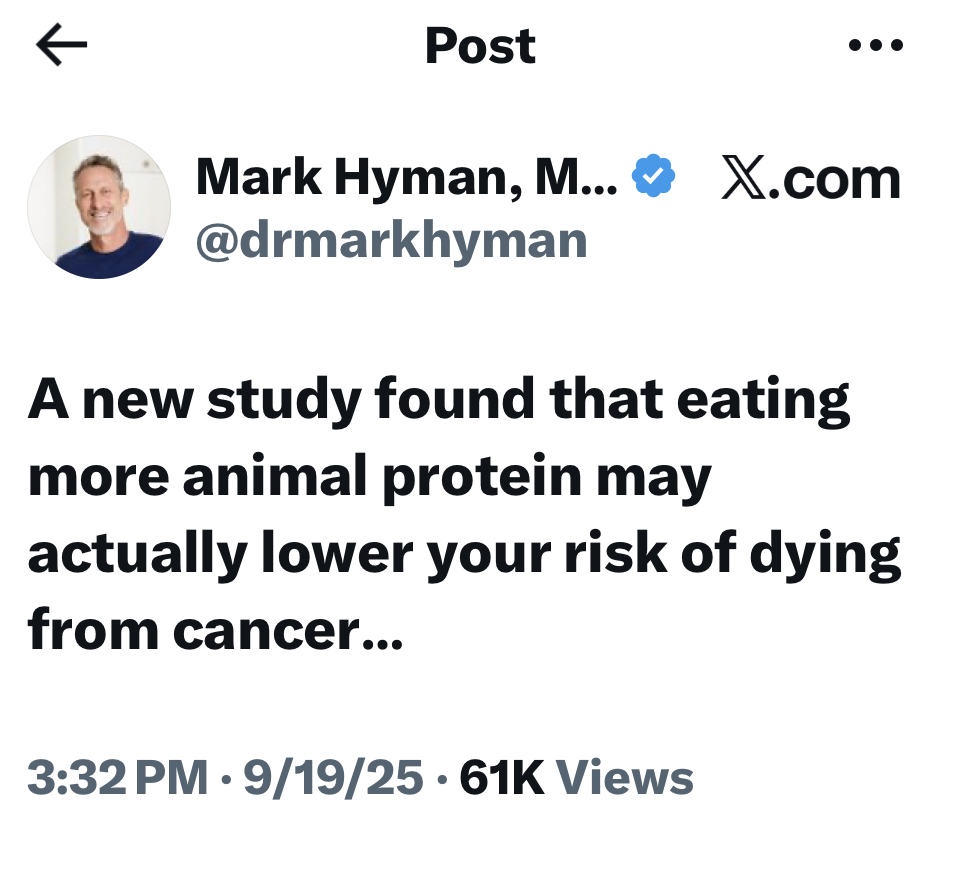
Recently, Mark Hyman posted on X (formerly Twitter) that a new study suggests eating more animal protein might actually lower your risk of cancer. The study he pointed to came from the NHANES dataset—a U.S. survey of diet and health. It sounded reassuring, but it doesn’t line up with the bulk of the evidence. Here is the story about Animal protein and cancer risk:
Let’s dig into what the science really shows.
Red and Processed Meats: Where the Risk Is Clear
If you want the strongest evidence, look at red and processed meats. Large prospective cohort studies and systematic reviews consistently show that higher intake of these foods increases cancer risk. The effect is clearest for colorectal cancer, but we also see it in breast, endometrial, and even lung cancer.[1–6]
How big is the risk? Recent meta-analyses and systematic reviews find relative risks (RRs) and hazard ratios (HRs) in the 1.10–1.30 range for the highest vs. lowest intakes. For example, a comprehensive meta-analysis reported that every 50–70 grams per day of red or processed meat increased colorectal cancer risk by 15–32% (HR 1.15–1.32).[3,5] Processed meat generally carries more risk than unprocessed red meat.[2–3,6]
That’s why the American Cancer Society recommends limiting red and processed meats. Their advice is clear: swap them out for fish, poultry, or legumes when possible.[15]
Fish: A Safer Bet
The data on fish tells a different story. Multiple studies and meta-analyses find a modest reduction in colorectal cancer risk with higher fish intake (SRR 0.94, 95% CI 0.89–0.99).[7–8] In fact, adding 50 grams of fish per day reduces risk by about 4%.
Pescatarian diets (no red meat, but including fish) show even more protection. Compared to meat-eaters, pescatarians had a 9% lower overall and colorectal cancer risk (RR 0.91, 95% CI 0.86–0.96).[9]
Poultry: Mostly Neutral
Chicken and turkey usually get lumped in with “animal protein.” But when you pull the data apart, poultry tells a different story. Most meta-analyses show a neutral or even slightly protective association with colorectal cancer (RR 0.79, 95% CI 0.63–0.99 for white meat).[10–12]
That said, a few studies hint at possible links with certain blood cancers, but those findings aren’t strong or consistent.[5,10] For most people, poultry is a much safer choice than red or processed meats.
Dairy: A Mixed Picture
Dairy is tricky. On one hand, milk and calcium-rich foods are consistently linked to a lower risk of colorectal cancer (RR 0.93, 95% CI 0.91–0.94).[4,13] On the other hand, high intake of milk or calcium may slightly increase the risk of prostate and endometrial cancers (RR 1.09–1.10).[13–14]
No consistent associations are found for breast or ovarian cancer. Cheese intake in particular may even have protective effects, but results vary.
Why the Confusion?
So why did that NHANES study Mark Hyman highlighted find a small reduction in cancer mortality with higher animal protein? A few reasons:
-
NHANES relies on a single dietary recall—one snapshot in time that may not reflect long-term habits.
-
It doesn’t separate red and processed meat from healthier animal proteins like fish or poultry.
-
Residual confounding (differences in lifestyle factors that aren’t fully accounted for) may skew the results.
When you put NHANES side by side with larger, longer-term studies and meta-analyses, it looks like the outlier. The overwhelming weight of evidence shows that red and processed meats increase cancer risk, while fish, poultry, and some dairy products are safer or even protective in specific cases. Animal protein and cancer risk is positive.
The Bottom Line
Protein matters—but the source matters more.
-
Red and processed meats: consistently linked to higher cancer risk
-
Fish: modestly protective, especially for colorectal cancer
-
Poultry: generally neutral, sometimes protective
-
Dairy: lowers colorectal risk, but may raise prostate and endometrial cancer risk
The American Cancer Society sums it up well: limit red and processed meats, and lean into fish, poultry, beans, and plant-based proteins.[15]
Risk Table: Animal Protein and Cancer
| Animal Protein Source | Cancer Type(s) | Risk Estimate (High vs. Low) | Direction of Association | References |
|---|---|---|---|---|
| Red meat | Colorectal | RR 1.10–1.22 | Increased risk | [1–4] |
| Colon | RR 1.13–1.22 | Increased risk | [1–3] | |
| Rectal | RR 1.22 | Increased risk | [1–3] | |
| Breast | RR 1.09 | Increased risk | [1,5] | |
| Endometrial | RR 1.25 | Increased risk | [1,5] | |
| Lung | RR 1.26 | Increased risk | [1,5] | |
| Processed meat | Colorectal | RR/HR 1.18–1.21 | Increased risk | [1–4,6] |
| Colon | RR 1.21 | Increased risk | [1–3] | |
| Rectal | RR 1.22–1.24 | Increased risk | [1–3] | |
| Fish | Colorectal | SRR 0.94 | Decreased risk | [7–9] |
| Colon/Rectal | RR 0.74–0.96 | Decreased risk | [7,9–10] | |
| Poultry/White meat | Colorectal | RR 0.79 | Neutral/decreased risk | [10–12] |
| Dairy (milk/calcium) | Colorectal | RR 0.93 | Decreased risk | [4,13] |
| Dairy (milk/calcium) | Prostate | RR 1.09–1.10 | Increased risk | [13–14] |
| Dairy (total) | Endometrial | RR 1.09–1.10 | Increased risk | [13] |
References
[1] Rock CL, Thomson C, Gansler T, et al. CA Cancer J Clin. 2020;70(4):245-271.
[2] Abid Z, Cross AJ, Sinha R. Am J Clin Nutr. 2014;100 Suppl 1:386S-93S.
[3] Lippi G, Mattiuzzi C, Cervellin G. Crit Rev Oncol Hematol. 2016;97:1-14.
[4] Boada LD, Henríquez-Hernández LA, Luzardo OP. Food Chem Toxicol. 2016;92:236-244.
[5] Diallo A, Deschasaux M, Latino-Martel P, et al. Int J Cancer. 2018;142(2):230-237.
[6] Farvid MS, Sidahmed E, Spence ND, et al. Eur J Epidemiol. 2021;36(9):937-951.
[7] Poorolajal J, Mohammadi Y, Fattahi-Darghlou M, et al. PLoS One. 2024;19(6):e0305994.
[8] Vieira AR, Abar L, Chan DSM, et al. Ann Oncol. 2017;28(8):1788-1802.
[9] Parra-Soto S, Ahumada D, Petermann-Rocha F, et al. BMC Med. 2022;20(1):79.
[10] Nielsen TB, Würtz AML, Tjønneland A, et al. Br J Nutr. 2022;127(4):563-569.
[11] Bonfiglio C, Tatoli R, Donghia R, et al. Nutrients. 2025;17(8):1370.
[12] Wang F, Chandler PD, Zeleznik OA, et al. Nutrients. 2022;14(5):978.
[13] Willett WC, Ludwig DS. N Engl J Med. 2020;382(7):644-654.
[14] Watling CZ, Kelly RK, Dunneram Y, et al. Br J Cancer. 2023;129(4):636-647.
[15] American Cancer Society. Guidelines for Diet and Physical Activity for Cancer Prevention. CA Cancer J Clin. 2020;70(4):245-271.
