
The Bank of Muscle: Why Your Real Retirement Account Isn’t Your 401(k)
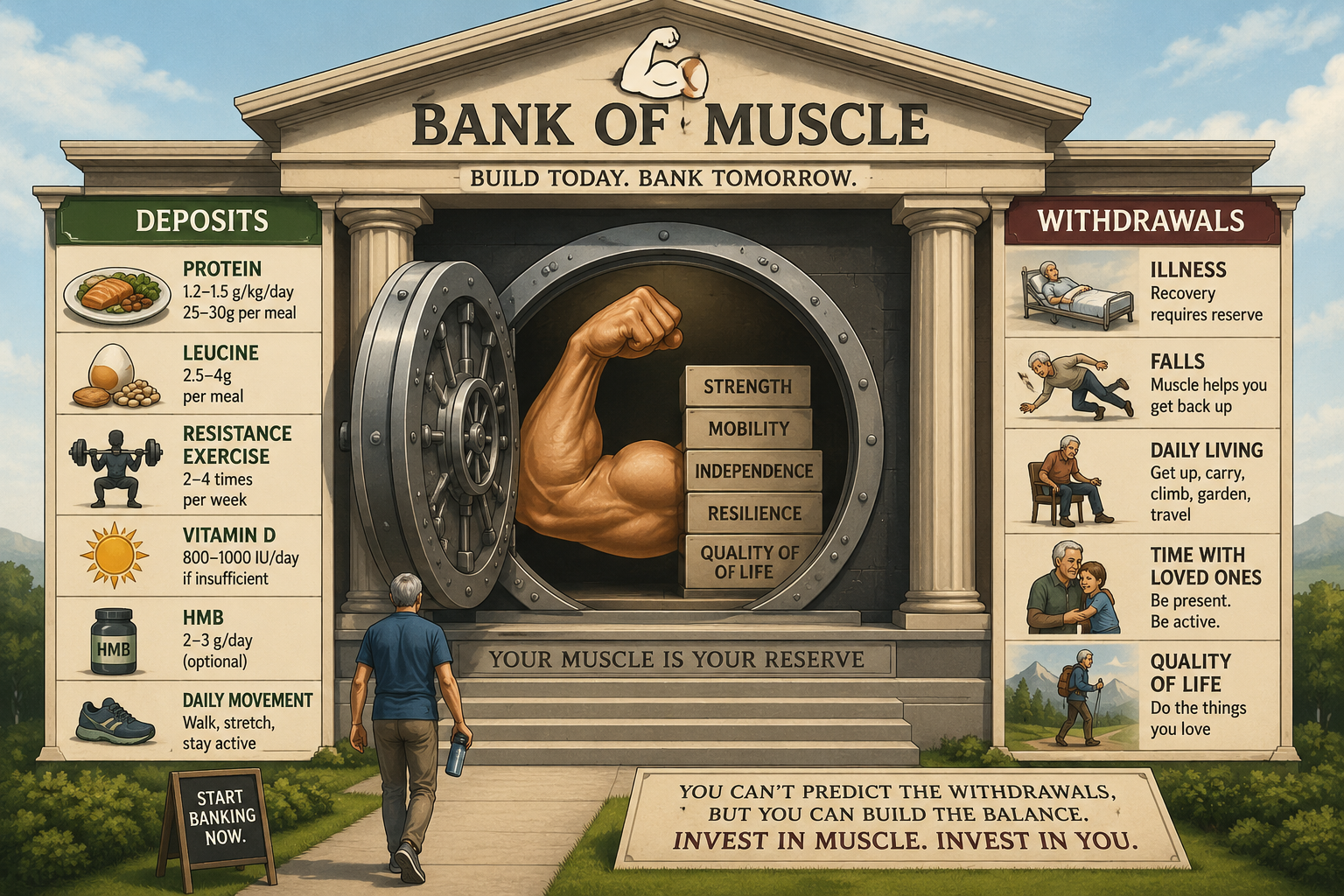
Bank of Muscle
I used to think retirement planning was all about money. Put enough away, let compound interest do its thing, and someday you’ll enjoy the rewards. As I’ve gotten older, however, I’ve come to appreciate another form of savings that may be just as important.
It’s your muscle.
Nobody reaches eighty-five and wishes they had less of it. Instead, people wish they could get out of a chair more easily. They wish they could carry groceries, travel, garden, and play with grandchildren. In other words, they wish they had more reserves.
That’s really what muscle buys us.
Dad’s First Retirement Account
I was fortunate. My father lived nearly ninety-nine years old, and he didn’t simply survive. He lived.
At eighty-five, Dad was walking three and a half miles every day. That’s remarkable. Many people half his age don’t walk that much. He had survived several heart attacks over the years, but he had reserves. Looking back, I realize that making it to eighty-five is one thing. Reaching eighty-five healthy enough to begin the sprint into your nineties is something else entirely.
Dad didn’t do anything exotic. He wasn’t biohacking. He wasn’t chasing supplements. He wasn’t optimizing every laboratory value.
He walked.
And my mother cooked.
Their meals weren’t complicated. They enjoyed meat, potatoes, vegetables, soups, and desserts. They enjoyed life together. In hindsight, Dad was making deposits into his Bank of Muscle every day without ever calling it that.
Then Life Changed
As my mother’s dementia slowly progressed, things began to fall apart. Dad stopped walking, not because he wanted to, but because he didn’t want to leave Mom alone. He worried she might wander. At the same time, Mom stopped cooking.
Breakfast became something out at a diner. Lunch might be a sandwich. Dinner often became cereal.
I watched them both lose weight.
Then I got the phone call no child wants.
“Dad’s in the hospital. He fell and couldn’t get up.”
The fall wasn’t the problem. Falls happen. What concerned me was that Dad no longer had enough reserve.
After a couple of weeks in rehabilitation, I convinced him to move into an assisted living center close to our house. He wasn’t thrilled with the idea, but something remarkable happened. Once Mom entered memory care and Dad had regular meals again, he began to thrive.
He complained constantly about the food while gaining seventeen pounds. But he made friends and was always talking to someone or another. I would drive by and see him talking to anyone from former Supreme Court Justice Sandra Day O’Conner, who lived there -and had a crush on my dad. My dad was making sure his neighbor got the newspaper, and yet he continued to complain about the food. All while gaining 17 pounds the first year.
Twice a week, I would take Dad to dinner, and we would split a steak.
The waitresses had a standing joke. They would ask him whether he wanted the kale salad.
Dad would smile and say, “I grew up in an orphanage in Alaska. We grew kale, but we fed it to the cows. I’ll eat the cow.”
He charmed every waitress in town.
Eventually, after Mom died, Dad moved back home to Oregon and lived independently again. Visiting Angels helped with meals and companionship, but he was back in his own house.
Looking back, I learned two things.
Food matters.
Muscle matters.
Frailty Is the Enemy
We spend a lot of time talking about heart disease, cancer, cholesterol, and blood pressure. Those are important. However, frailty is another great enemy of aging.
Frailty steals independence.
One broken hip can change everything. A fall that would have been a nuisance at sixty can become life-changing at eighty-five. Muscle gives us reserve, and reserve allows us to recover.
My father didn’t avoid every setback.
He survived them.
That’s what reserve does.
Protein Helps, But It Isn’t Magic
The supplement industry would love us to believe that a powder is all we need. Unfortunately, muscles didn’t get the memo.
Protein matters, especially as we age. Most experts recommend older adults consume about 1.2 to 1.5 grams of protein per kilogram of body weight each day, spread throughout the day rather than eaten all at once at dinner. For many people, that means aiming for twenty-five to thirty grams of protein at each meal.¹
However, protein alone isn’t enough.
A large meta-analysis found that protein supplementation without resistance exercise had limited effects on strength and muscle mass. In contrast, combining protein with resistance exercise produced meaningful improvements.²
In other words, muscles need both building blocks and a reason to keep existing.
Exercise Doesn’t Have To Be Fancy
When people hear “resistance exercise,” they often picture bodybuilders.
That’s not what the science requires.
Walking hills counts.
Gardening counts.
Resistance bands count.
Swimming counts.
Carrying groceries counts.
Yoga counts.
For me, yoga became the answer.
I’m not a gym person. Exercise isn’t my hobby. I don’t wake up every morning excited to work out. I do yoga because I know future Terry will appreciate it.
I’m not training for the Olympics.
I’m training for my eighties.
Real Food Still Works
Whey protein is probably the most studied supplement because it’s rich in leucine, an amino acid that helps stimulate muscle protein synthesis. As we age, muscles become less sensitive to that signal, which is why getting enough leucine becomes increasingly important.¹
Fortunately, you don’t need expensive powders.
Eggs, fish, dairy products, soy, beans, chicken, and meat all provide excellent protein.
Personally, whey protein and I are not close friends. I’ve had lactose intolerance for years, and the slower gut that comes with GLP-1 therapy has made me even less tolerant of many whey products. Add stevia, sugar alcohols, and various flavorings, and my intestines politely object.
Instead, I use egg protein or plant proteins. I avoid stevia because it tastes like electrical tape to me, and I don’t need a chemistry experiment in a shaker bottle.
Still, I recognize supplements have a role.
If you’re on a GLP-1 medication and eating less, or if you’re simply busy, a protein shake or bar can be a useful tool. They aren’t magic.
They’re convenient.
A Father’s Wisdom
After Mom died, Dad came to live with me in California. By then, I had discovered yoga.
Dad teased me about it at first.
Then one day, he looked at me and said something I’ve never forgotten.
“I think you doing yoga is great. You’re the right age. Doing this now is important. If yoga is what you like, buy all the spandex you want and keep doing it.”
Those words stayed with me.
You’re the right age.
Doing this now is important.
If you’re lucky, your parents give you wisdom throughout your life. When you’re young, you roll your eyes. Later, you realize those words become part of who you are.
Money gets spent.
Wisdom gets carried.
Dad wasn’t telling me to do yoga.
He was telling me to keep moving.
Make Deposits
Every age has different priorities.
At twenty-five, you may be building a career.
At forty-five, you may be raising children.
At sixty-five, you may be protecting your muscles.
At eighty-five, you may simply want enough reserve to get out of a chair and go to dinner with your family.
The body doesn’t really care whether those deposits come from yoga, barbells, swimming, pickleball, or walking.
It only cares that you keep making deposits.
Because someday you’ll need to make a withdrawal.
Life guarantees that.
When that day comes, you’ll be grateful for every walk, every stretch, every protein-rich meal, and every little thing you did, not because you loved doing them, but because they built reserve.
Healthy aging isn’t about dying young as slowly as possible.
It’s about building enough reserve so that when life knocks you down, you still have enough strength to get back up.
And that may be the most important retirement account you’ll ever own.
References
- Bauer J, Biolo G, Cederholm T, et al. Evidence-based recommendations for optimal dietary protein intake in older people: a position paper from the PROT-AGE Study Group. J Am Med Dir Assoc. 2013;14(8):542-559.
- Liao CD, Tsauo JY, Wu YT, et al. Effects of protein supplementation combined with resistance exercise on body composition and physical function in older adults: a meta-analysis. American Journal of Clinical Nutrition. 2017;106(4):1078-1091.
- Cruz-Jentoft AJ, Bahat G, Bauer J, et al. Sarcopenia: revised European consensus on definition and diagnosis. Age and Ageing. 2019;48(1):16-31.
