
The “Real Food” Protein Bar
There may be no phrase in modern nutrition more ridiculous than this:
“Real food protein bar.”
And yet, somehow, we are expected to nod seriously when someone says it.
Recently, internet nutrition personality Paul Saladino introduced what he described as his best “real food” protein bar. While I have nothing personal against the man. I admire the confidence required to sell twelve protein bars for forty-four dollars while talking about ancestral living.
Because let’s be honest for a moment.
Protein bars are the modern candy bar.
They simply come wrapped in better branding, cleaner fonts, and enough wellness language to make people feel virtuous while eating what is essentially an expensive Snickers bar with a podcast sponsorship.
Now, before the internet declares me anti-protein-bar, let me clarify something immediately.
I actually like Aloha bars.
They’re expensive, but they say the right words to me. More importantly, they taste better than most compressed drywall products pretending to be nutritious. At the same time, real life exists, and sometimes convenience matters because airports happen, traffic happens, and long clinic days happen.
Still, pretending industrial engineering somehow untouches these foods is a bit like pretending woodland elves handcrafted a Tesla.
Breakfast Used to Be a Moral Lecture

Inventor of breakfast cereal, surgeon, health writer, and vegetarian
To understand how we got here, we need cereal, because cereal tells the entire story of modern food in one aisle.
The first cereals in America were essentially granolas—dense grain mixtures that required chewing, preparation, and a bit of commitment. While nobody was exactly dreaming about them at night, they solved an important problem because they stored well, traveled well, and provided calories in an expanding industrial society.
Then along came John Harvey Kellogg.
Now, Kellogg was brilliant, strange, deeply moralistic, and profoundly suspicious of pleasure. He believed rich foods, spicy foods, meat, and almost anything enjoyable stimulated dangerous passions, and among those passions, he was particularly terrified of masturbation, which he viewed as one of the great threats to civilization.
So his answer was blandness.
Very blandness.
Little sugar. Little excitement. Little stimulation.
The original breakfast cereal movement was not designed around pleasure.
Instead, it was designed around suppression.
In many ways, those cereals were crunchy moral discipline.
Then the Cereal Aisle Became Las Vegas
Fast forward a hundred years, and the cereal aisle becomes the exact opposite of Kellogg’s vision.
Sugar increases dramatically.
Crunch becomes engineered.
Colors explode across the box.
Mascots arrive to recruit children before they can read.
Eventually, breakfast stops being a health intervention and slowly transforms into dessert with vitamins sprinkled on top.
And importantly, none of this happened because someone woke up wanting to destroy public health.
That’s the part people often misunderstand.
Food Engineering Solved Real Problems
Before obesity became the dominant nutritional problem, the real challenge facing humanity was hunger.
For most of history, people worried about:
- starvation
- food spoilage
- crop failures
- transportation
- and simple calorie availability
Modern food engineering changed that reality.
Shelf-stable foods mattered.
Affordable calories mattered.
Transportation mattered.
Refrigeration mattered.
And honestly, millions upon millions of lives have been improved because of those advances.
It is very easy for people with stocked refrigerators and grocery delivery apps to romanticize the past, but the past involved a tremendous amount of malnutrition, uncertainty, and hunger.
So modern food systems were not evil.
They were revolutionary.
The Problem Changed
However, in solving one problem, we slowly created another.
Because once calories became:
- cheap
- portable
- stable
- and endlessly available
…the challenge was no longer finding enough food.
The challenge became stopping.
And this is where modern biology collides with the modern grocery aisle.
Our brains evolved in environments where calorie-dense food was rare and valuable. Suddenly, within just a few generations, we found ourselves surrounded by foods engineered to be affordable, repeatable, and highly rewarding.
That mismatch matters.
Extrusion Changed Everything
Most people have never heard the word extrusion, even though it may be one of the most important food technologies in modern life.
The process is simple.
Take starches, grains, or protein powders.
Apply heat and pressure.
Force them through machinery.
Suddenly, you have:
- cereal
- crackers
- cheese puffs
- protein snacks
- breakfast bars
And here is the important part: extrusion changes texture, and texture changes satiety.
When food crunches perfectly, dissolves quickly, and slides down effortlessly, people consume more of it before fullness has time to register.
That is not a conspiracy.
It is simply biology interacting with engineering.
The Grocery Store Became Natural Selection
Food companies did not necessarily set out to create hyper-palatable foods.
Instead, they followed what sold.
And what sold was what people returned to again and again.
So over time, the grocery aisle became a form of natural selection.
Products survived because they triggered pleasure effectively.
Foods that didn’t simply disappear.
And I will confidently say something controversial:
Reese’s sells better than Brussels sprouts.
I will die on that hill.
Now, yes, Brussels sprouts can be delicious roasted with olive oil and balsamic, and somewhere at this exact moment, a chef in Brooklyn is shaving them raw onto handmade pottery while explaining their emotional complexity.
Still, Reese’s triggers something primal.
Sweetness.
Fat.
Salt.
Texture.
And your brain immediately says:
“Yes. More of that.”
Food Is Emotional
Food is not just chemistry.
Food is memory.
It is also culture.
What we eat is comfort.
For some people, comfort food is a tamale. For others, it’s lefse. Meanwhile, many people find that comfort in peanut butter cups or a Dove Bar.
The grocery aisle evolved around those emotional realities much faster than human biology evolved to manage them.
And that matters, because modern eating is not simply about willpower.
It is about environment.
Cooking Changes the Experience
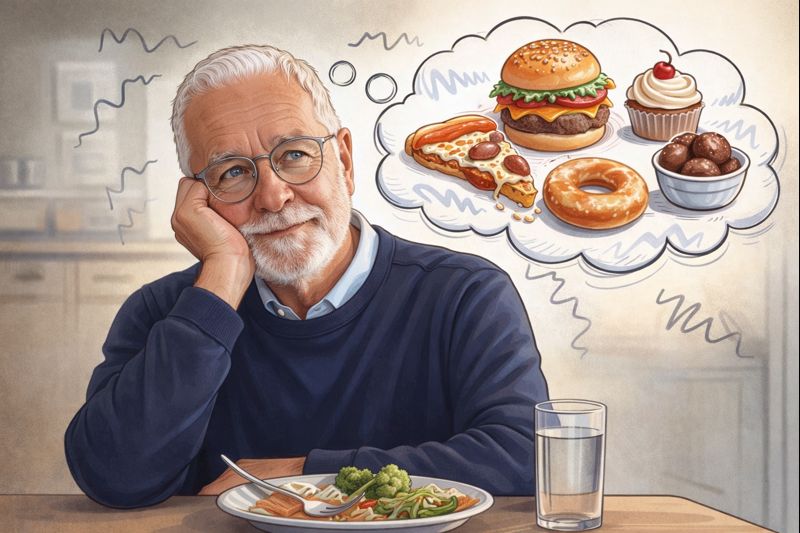
Now compare all that to actual cooking.
Not content-creator cooking.
Real cooking.
A stew simmering slowly.
A roast chicken filling the kitchen with aroma.
A tagine building layers of flavor from preserved lemon, apricots, and warm Moroccan spices.
That kind of food slows you down.
You smell it before you eat it.
You notice texture.
You experience layers of flavor.
And interestingly enough, you often need less of it to feel satisfied.
That is one of the great ironies of modern eating.
As food became more engineered for efficiency, it often became less satisfying experientially.
The Wellness Fantasy
There is another uncomfortable reality that nobody on wellness Instagram likes to admit.
In order to feed a hungry planet, we cannot all live on pasture-raised beef, farm-fresh eggs gathered from cheerful backyard chickens, and organic kale harvested by a local poet-farmer wearing linen.
That is not a food system.
That is a lifestyle catalog.
The modern world has eight billion people.
Food has to:
- travel
- survive droughts
- survive wars
- survive supply chain failures
- and feed cities that no longer produce their own calories
Engineered foods are not going away.
Nor should they.
Yes, Even on Mars
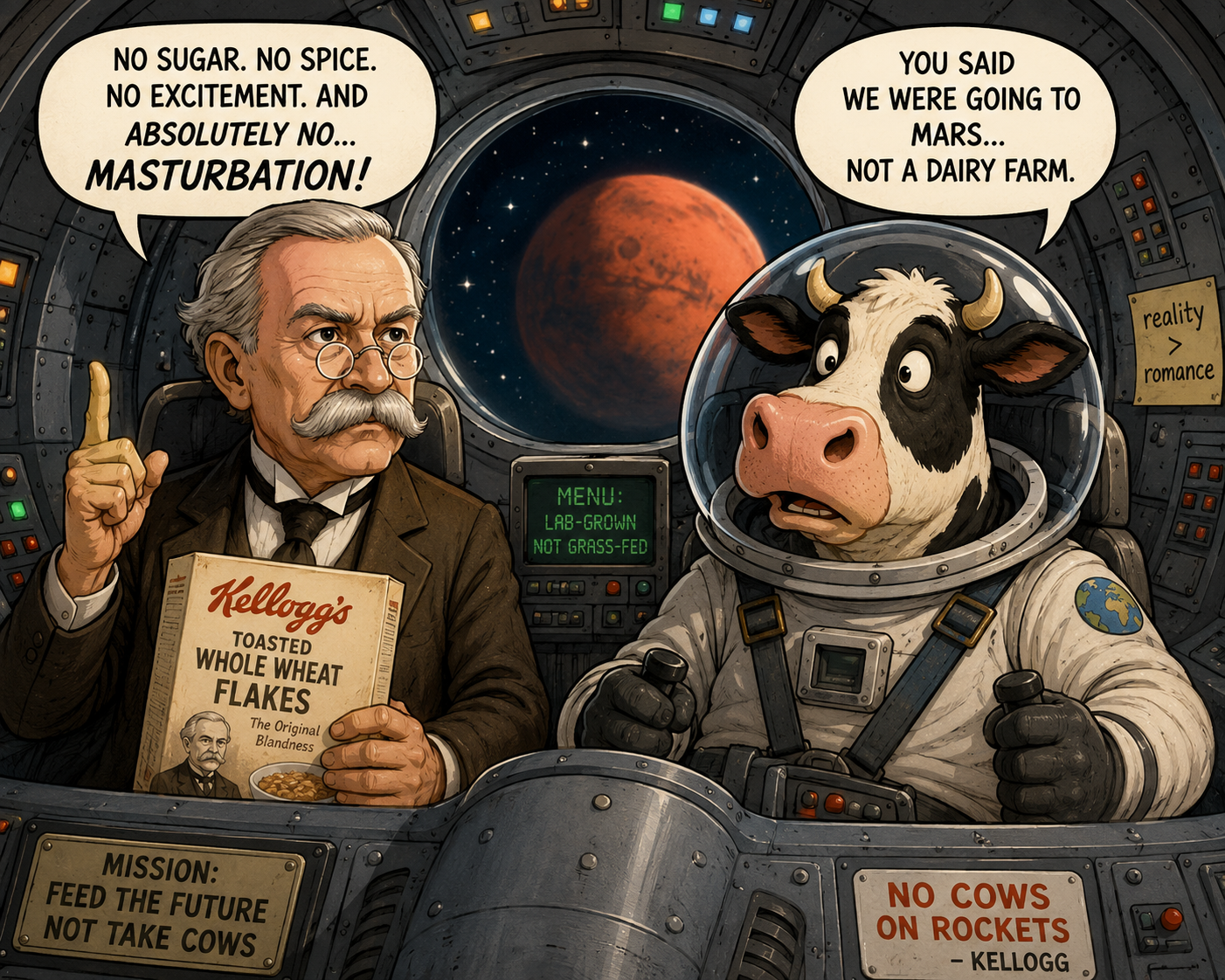
When human beings eventually colonize Mars, we are not putting cattle on the rocket ship.
Nobody is building a space ranch outside Olympus Mons.
Likewise, we are not stocking the moons of Jupiter with artisanal grass-fed herds wandering peacefully beneath methane clouds.
Instead, we will use engineered foods and lab-grown proteins, because they will be:
- efficient
- reproducible
- resource-conscious
- and eventually taste just as good
That future is not dystopian.
It is practical.
The Real Challenge Now
The challenge facing us today is very different from the challenge facing humanity a century ago.
We no longer live in a world where most people fear starvation.
Instead, we live in a world where many people are simultaneously overfed and undernourished.
Calories are abundant.
Satiety is not.
And that is where medications like GLP-1 are helping many people—including me—regain a sense of balance and reality in a food environment that our brains were never designed to navigate.
Food Is Not the Enemy
Food is not evil.
Engineering is not automatically bad.
Convenience matters, and sometimes a protein bar is perfectly fine.
However, pretending that heavily processed convenience foods become “real food” because someone added collagen and an Instagram strategy does not help anyone understand the real issue.
The goal is not perfection.
The goal is awareness.
We need food systems that:
- reduce malnutrition
- prevent shortages
- improve satiety
- and avoid creating environments where obesity becomes the default outcome of modern life
Because feeding humanity was one of civilization’s greatest achievements.
Now we simply have to figure out how to do it without overwhelming the biology that got us here in the first place.
